Programmatic advertising was supposed to make media buying easier. Instead of negotiating every placement manually, advertisers could use software to purchase impressions, reach relevant audiences, and adjust campaigns in real time.
It worked. But it also created an advertising ecosystem that can be difficult to navigate.
There are demand-side platforms, supply-side platforms, exchanges, audience data providers, verification tools, and reporting systems. Each generates its own information, and not all of it tells the same story.
Now artificial intelligence is changing how those systems operate.
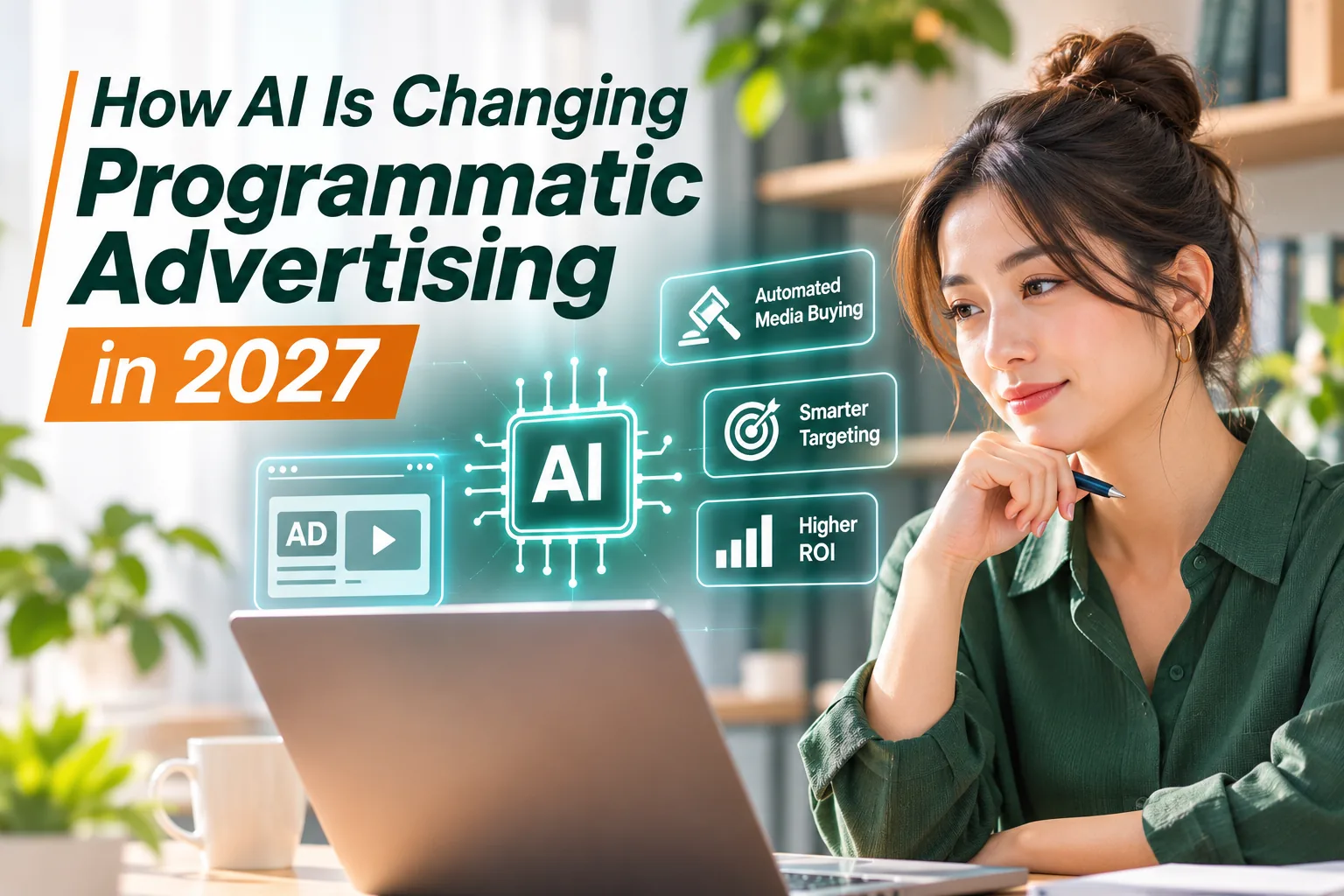
As 2027 approaches, AI is taking on a larger role in campaign planning, bidding decisions, inventory evaluation, and performance measurement. Some of these capabilities are already embedded in advertising platforms. Others, particularly autonomous AI agents that can coordinate media transactions, are still developing.
For agencies and advertisers, the opportunity is significant. So is the risk of handing increasingly important decisions to systems that aren’t always easy to understand.
The interesting question is no longer whether AI will influence programmatic advertising. It already does.
The real question is how much control advertisers should give it.
Programmatic Advertising Was Automated Long Before Generative AI
It’s worth clearing up a common misconception: programmatic advertising and artificial intelligence are not the same thing.
Programmatic advertising refers to the automated buying and selling of digital advertising inventory. In many environments, demand-side platforms (DSPs) evaluate available impressions and submit bids through real-time bidding (RTB) systems.
The process can happen in milliseconds.
Advertisers establish campaign objectives, targeting criteria, budgets, and bidding conditions. The technology then helps determine which advertising opportunities match those requirements.
Machine learning has supported parts of this process for years.
What’s changing is the scope of the decisions AI can influence.
Previously, automation might focus primarily on bid adjustments or individual campaign variables. More advanced AI systems can help analyze broader patterns across inventory, audience signals, creative performance, and campaign outcomes.
The distinction matters because faster automation alone doesn’t guarantee smarter advertising.
An automated system can execute a poor strategy very efficiently.
AI becomes valuable when it helps advertisers make better decisions, not simply more decisions.
From Automated Bidding to Predictive Media Buying
Consider a performance campaign with a fixed daily budget.
A conventional bidding strategy may prioritize impressions based on historical conversion rates, predefined audience characteristics, and platform optimization rules.
AI-driven predictive bidding can take a more dynamic approach.
Depending on the platform, models may consider contextual signals, historical engagement patterns, time of day, device characteristics, inventory quality, and predicted conversion likelihood.
The goal is to estimate the value of an advertising opportunity before deciding how aggressively to bid.
This creates several possibilities.
An impression that appears inexpensive may actually offer limited value if similar traffic rarely converts. Another placement may cost more but reach an audience with stronger purchase intent.
A well-trained model can help distinguish between those situations.
Of course, predictions are only as useful as the information supporting them.
Poor conversion tracking, inconsistent event definitions, or biased training data can lead to misleading recommendations.
The Problem With Optimizing the Wrong Metric
Imagine an agency managing advertising for a subscription-based service.
Its automated campaigns are optimized toward registrations, and the reported cost per registration steadily declines.
On paper, performance looks excellent.
But a closer inspection reveals that many newly registered users never become paying customers.
The algorithm has successfully optimized the metric it was given. Unfortunately, that metric doesn’t represent the client’s actual business objective.
A more useful approach might consider qualified leads, paid subscriptions, customer retention, or expected lifetime value.
This is where experienced media buyers remain important.
AI can optimize toward an objective. The agency still needs to make sure it’s the right objective.
Agentic Advertising Could Change How Media Is Bought
One of the more interesting developments heading into 2027 is agentic advertising.
Unlike traditional automation, which generally follows defined workflows and optimization rules, agentic AI systems are designed to complete broader tasks through multiple coordinated actions.
In advertising, that could eventually include researching inventory opportunities, comparing media proposals, recommending budget allocations, and coordinating parts of the buying process.
An agency might provide an AI agent with campaign objectives, audience requirements, spending limits, and quality standards.
The agent could then assist with identifying suitable advertising options and evaluating proposals against those requirements.
This is not a hypothetical concept without industry activity behind it.
The IAB Tech Lab has been developing Agentic Advertising Management Protocols (AAMP) to establish shared technical foundations for AI-driven advertising workflows.
Its 2026 AAMP 3.0 work includes OpenProposal, an approach to standardizing parts of the process between receiving a media request and progressing toward a buying commitment.
For advertisers, the long-term appeal is clear: fewer disconnected manual processes and better coordination between buying and selling systems.
But the industry hasn’t reached a point where autonomous media buying can be treated as universally mature.
The 2026 IAB Europe AI survey found divided expectations about how quickly agentic buying would become part of day-to-day advertising transactions.
Some participants expected meaningful adoption within a year. Others anticipated further development without large-scale deployment.
That uncertainty should shape how agencies approach the technology.
Why Human Approval Still Matters
An AI agent that recommends a media plan is one thing.
An AI agent that independently commits a substantial advertising budget is another.
The second scenario introduces questions about authorization, accountability, security, and the ability to reverse decisions.
Who approves an unfamiliar inventory source? What happens when a system misinterprets budget limits? How can an agency audit the steps an AI agent took?
For now, a sensible operating model is to expand automation gradually while retaining clear human oversight for high-impact decisions.
The objective should be better media buying, not automation for its own sake.
The Advertising Supply Chain Is Becoming an Optimization Target
Programmatic advertising involves more than choosing an audience and submitting a bid.
Between an advertiser and a publisher, inventory may pass through several technology providers and commercial relationships.
This creates opportunities for scale, but also introduces costs and complexity.
Supply path optimization (SPO) aims to improve how advertisers access inventory by evaluating the routes through which impressions are purchased.
AI can assist this process by analyzing patterns across supply sources, auction outcomes, fees, viewability, and available quality signals.
For example, two different supply paths may offer access to similar publisher inventory.
If one consistently introduces unnecessary costs without improving delivery quality, an advertiser may have a reason to reconsider that route.
AI can help surface these patterns across large datasets.
However, not every supply path is directly comparable, and cost isn’t the only consideration.
Inventory quality, auction access, buyer protections, and transparency all matter.
Transparency Is Still a Competitive Advantage
As programmatic systems become more automated, advertisers will need better visibility into the decisions being made on their behalf.
They should understand which inventory sources are eligible, what verification measures are applied, and how results are reported.
AI doesn’t remove the need for transparency. It arguably makes transparency more important.
A system that optimizes media spend without sufficient reporting may improve short-term efficiency while making campaign performance harder to explain.
For agencies, the ability to connect automated decisions with understandable business outcomes could become a meaningful competitive advantage.
Creative Optimization Is Moving Closer to Media Buying
Programmatic technology has historically focused heavily on media delivery.
Creative development often happened through a separate process.
A design team produced the assets. A media team launched them. Performance results eventually informed another creative brief.
AI is making that workflow more connected.
Generative tools can help teams develop multiple creative variations, while performance models can identify which combinations of messaging and formats are producing stronger outcomes.
Dynamic creative optimization (DCO) can then use applicable signals and platform capabilities to select or assemble advertising variations.
Consider a retailer promoting several product categories.
Different audiences may respond to different messages. One group might be interested in price, while another cares more about reliability, convenience, or product features.
Instead of presenting every audience with identical creative, a campaign can test more relevant combinations.
The challenge is maintaining a consistent brand identity.
An advertisement that wins an individual performance test isn’t necessarily the best representation of the brand.
Short-term conversion signals can also favor aggressive messages that may not support long-term customer trust.
Creative optimization works best when advertising performance and brand strategy are treated as complementary goals.
AI can help identify patterns. Human creative direction is still needed to decide which patterns are worth following.
First-Party Data and Contextual Targeting Are Gaining Practical Importance
Audience targeting has become more complicated as advertising platforms operate under different privacy requirements, browser restrictions, and data-access policies.
This doesn’t mean every form of audience targeting is disappearing.
It means advertisers cannot assume the same identifiers and behavioral signals will always be available.
In that environment, first-party data and contextual targeting are increasingly useful.
First-party data can help businesses understand customer relationships through information collected directly from their own interactions, subject to applicable consent and privacy requirements.
Contextual targeting takes a different approach.
Instead of depending entirely on a user’s cross-site behavioral history, advertising can be matched to relevant content or environmental signals.
An advertiser promoting accounting software, for instance, may find suitable inventory alongside content about small-business operations, financial management, or entrepreneurship.
AI can support contextual classification by analyzing content and helping identify relevant advertising opportunities.
That doesn’t automatically make contextual targeting superior to every other strategy.
Performance depends on campaign objectives, inventory quality, creative relevance, and the measurement approach.
The more useful principle is to avoid excessive dependence on any single audience signal.
Connected TV and Digital Audio Add New Complexity
Programmatic advertising is no longer limited to conventional display banners.
Connected TV (CTV), digital audio, online video, and emerging commerce environments are expanding the types of inventory available through automated buying systems.
These channels create additional opportunities to reach audiences, but they also complicate campaign planning.
A video impression on a television screen is not equivalent to a display impression on a mobile website.
Attention patterns, creative expectations, measurement methods, and conversion behavior can differ significantly.
Comscore’s 2026 State of Programmatic research identified connected TV and digital audio as important areas of programmatic investment.
AI may help agencies evaluate audience overlap, campaign frequency, inventory combinations, and performance across these environments.
Still, combining multiple channels in one reporting dashboard doesn’t automatically produce a reliable omnichannel measurement system.
Agencies need to understand how metrics differ between environments and avoid treating every impression as interchangeable.
As media buying becomes more integrated, measurement discipline will matter just as much as automation.
Better AI Doesn’t Automatically Produce Better ROAS
Return on ad spend remains one of the most visible performance metrics in digital advertising.
It’s straightforward to calculate when attributed revenue and advertising spend are available.
But ROAS has limitations.
A campaign might report strong returns because it reaches customers who were already planning to purchase. Another campaign might introduce new customers who generate substantial value over several months but produce modest immediate revenue.
AI optimization systems can reinforce these differences depending on the objectives and conversion signals provided.
For that reason, campaign measurement in 2027 is likely to involve greater attention to incrementality, customer value, and cross-channel contribution.
What Agencies Should Measure Alongside ROAS
| Measurement Area | Question It Helps Answer |
|---|---|
| ROAS | How much attributed revenue did advertising generate relative to spend? |
| CPA | What did each attributed acquisition cost? |
| Incrementality | What additional outcomes occurred because of the advertising? |
| Customer Lifetime Value | How valuable are acquired customers over time? |
| Viewability and Invalid Traffic | How much delivered inventory met relevant quality standards? |
| Reach and Frequency | How broadly and repeatedly did the campaign reach its audience? |
These metrics don’t need to carry equal weight in every campaign.
A direct-response ecommerce campaign and a brand awareness campaign have different objectives.
The important part is deciding how success will be evaluated before automated systems begin optimizing toward it.
What AI Programmatic Advertising Might Look Like in 2027
The industry is moving toward more connected automation, but several developments remain uncertain.
Based on the direction of current technology and industry standards, a few scenarios appear plausible.
More AI-assisted media planning. Agencies may increasingly use intelligent systems to compare inventory options, evaluate historical results, and prepare recommendations before campaign activation.
Greater coordination between creative and media. Creative testing, audience selection, and bidding could become more closely connected through shared optimization workflows.
More selective use of autonomous agents. Agentic systems may begin handling defined tasks within approved boundaries, although broad deployment will depend on interoperability, security, and trust.
Stronger emphasis on supply transparency. Buyers are likely to demand clearer information about inventory quality, transaction costs, and how automated decisions are made.
Greater demand for measurement expertise. As campaign execution becomes easier to automate, understanding causal impact and business value may become more important.
None of these developments guarantees that every advertiser will adopt the same technologies at the same pace.
A large enterprise operating across several markets may have different requirements from a smaller business running a limited acquisition campaign.
The appropriate level of automation will depend on available resources, risk tolerance, and the complexity of the advertising strategy.
How Agencies Can Prepare Without Overcomplicating Their Operations
The most practical response to AI development isn’t replacing an agency’s entire technology stack overnight.
It’s identifying where existing workflows are inefficient, where campaign decisions rely on incomplete information, and where automation could support better outcomes.
Start with measurement.
If conversion tracking is unreliable, adding sophisticated bidding technology may simply increase the speed at which a campaign makes questionable decisions.
Then evaluate inventory quality and data access.
An agency should understand the advertising sources it uses and the information available for evaluating those placements.
From there, test AI-supported workflows in areas where the results can be reviewed and compared against established processes.
Reporting automation, audience analysis, inventory evaluation, and creative experimentation can all offer useful starting points.
For more consequential workflows, including budget changes and media commitments, define approval rules and accountability before expanding automation.
And keep the people responsible for campaign strategy involved.
A sophisticated advertising system can recommend where to spend money. It cannot independently determine whether the resulting campaign supports a client’s broader business priorities without reliable objectives and context.
A More Practical Approach With Saturnads.net
For businesses navigating the changes in programmatic advertising, the conversation should begin with campaign goals rather than technology labels.
At Saturnads.net, Saturn Digital Lab brings together advertising technology, tailored marketing strategies, AI-powered targeting, and data-driven insights as part of its digital advertising offering.
Those areas are closely connected to the challenges agencies face as programmatic advertising becomes more automated.
Whether the priority is improving audience targeting, understanding campaign performance, or exploring programmatic opportunities, the starting point remains the same: clear objectives, relevant advertising inventory, and reliable measurement.
Explore more about digital advertising and marketing technology at Saturnads.net.
Frequently Asked Questions
What is AI programmatic advertising?
AI programmatic advertising uses artificial intelligence and machine learning to support automated media buying, targeting, bidding, optimization, and performance analysis. Its capabilities vary across advertising platforms.
How is AI changing programmatic advertising in 2027?
AI is expected to play a larger role in predictive bidding, creative optimization, inventory evaluation, and campaign planning. Agentic advertising is also developing, although widespread autonomous buying remains uncertain.
What is the difference between programmatic advertising and AI advertising?
Programmatic advertising refers to automated systems for buying and selling advertising inventory. AI advertising is a broader term for using artificial intelligence in marketing activities, including media buying, creative production, analytics, and audience research.
Will AI replace programmatic media buyers?
AI can automate repetitive tasks and support increasingly complex advertising decisions, but strategy, budget accountability, quality control, and business judgment still require human involvement.
What is agentic advertising?
Agentic advertising involves AI systems designed to perform coordinated advertising tasks, potentially including research, planning, proposal evaluation, and aspects of media execution within defined rules.
Can AI improve programmatic advertising ROI?
AI can help improve efficiency through better bidding, audience analysis, and optimization. However, actual ROI depends on data quality, campaign goals, inventory, creative strategy, and measurement accuracy.
Why is transparency important in AI-powered media buying?
Advertisers need to understand how budgets are allocated, where advertisements appear, and how campaign outcomes are measured. Greater automation increases the importance of clear controls and accountability.
Where can I explore programmatic advertising solutions?
Visit Saturnads.net to learn about Saturn Digital Lab’s advertising technology, programmatic advertising, AI-powered targeting, and digital marketing services.
The Next Advantage May Be Knowing When Not to Automate
A few years ago, agencies competed partly on their ability to access and operate sophisticated advertising technology.
As AI becomes more widely available, that advantage may become harder to maintain.
More advertisers will have access to intelligent bidding systems, automated reporting, and AI-assisted campaign planning.
The difference won’t always come from having the newest platform.
It may come from recognizing when the data is unreliable, when a campaign is chasing the wrong objective, or when an apparently efficient buying strategy is missing valuable customers.
Automation can help agencies move faster.
Knowing where to go still requires judgment.
And that distinction is likely to become even more important as programmatic advertising enters 2027.