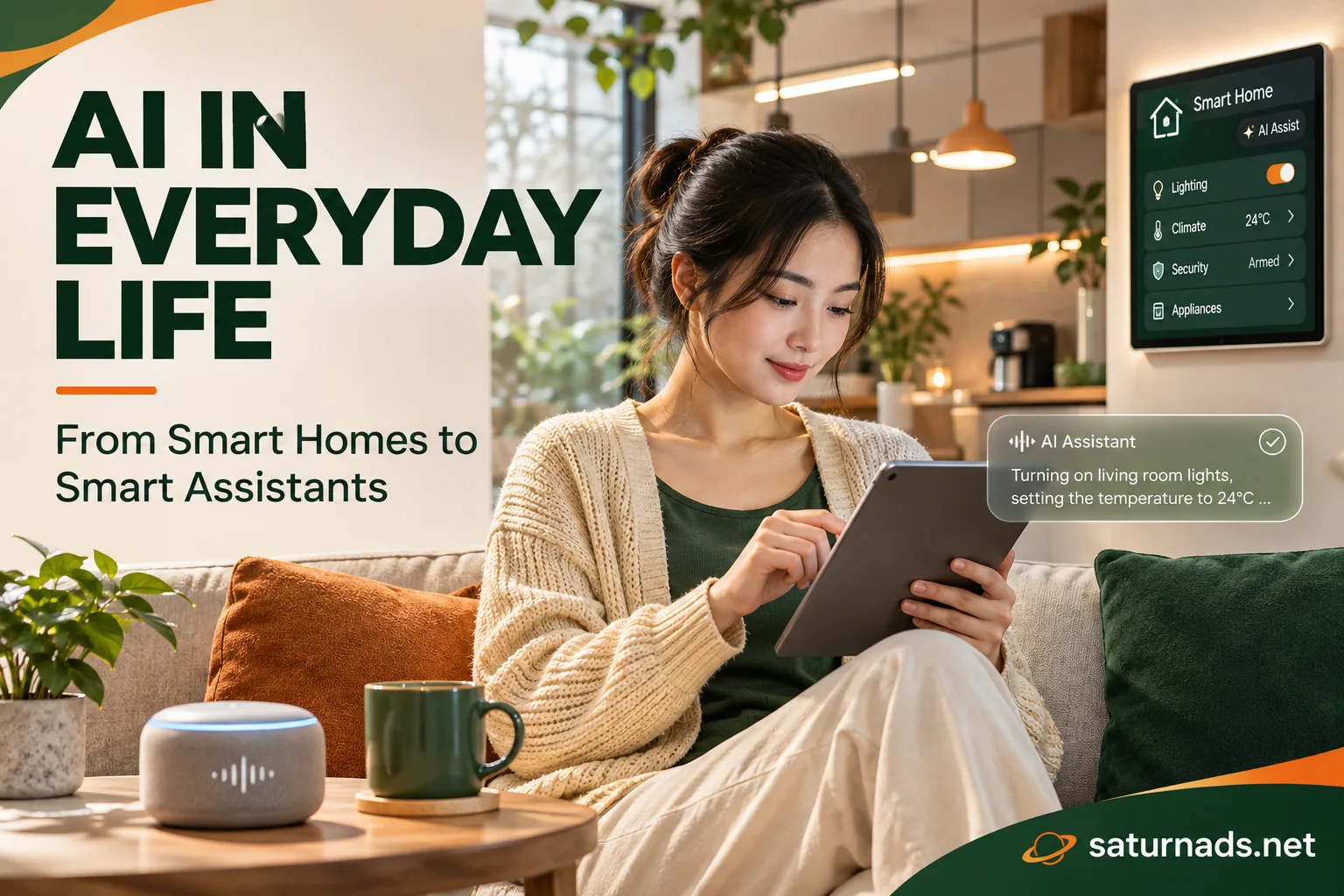
AI in Everyday Life: From Smart Homes to Smart Assistants
You probably used artificial intelligence today without thinking much about it.
Maybe your phone filtered an unwanted call. Your music app recommended a song that matched your taste. A navigation app suggested a faster route, or a smart speaker responded when you asked it to turn off the lights.
None of these moments feels particularly futuristic anymore.
That’s what makes artificial intelligence in everyday life so interesting. Its influence is growing not because every household suddenly has a robot, but because AI is becoming part of ordinary products, routines, and decisions.
Smart homes, voice assistants, personalized recommendations, and generative AI tools are making technology more responsive to individual needs.
But there’s another side to the story. The more connected our daily lives become, the more questions we need to ask about privacy, reliability, and how much control we’re comfortable handing over.
AI Is Already Part of Everyday Technology
Artificial intelligence is often described as a technology of the future. In reality, many of its practical applications have been around for years.
Email spam filters use machine learning to recognize suspicious messages. Navigation systems estimate travel conditions using available traffic data. Recommendation engines help streaming platforms decide which content to suggest.
Even smartphone cameras use AI-supported image processing to improve photographs under different lighting conditions.
These technologies don’t necessarily announce themselves as artificial intelligence.
They simply work in the background.
The difference today is that AI systems are becoming more capable of understanding language, interpreting information, and helping people complete increasingly complex tasks.
Generative AI has accelerated that shift by making it possible to interact with technology through everyday conversation.
Instead of navigating several menus, users can ask questions, explain what they want, and receive assistance in a more natural format.
That doesn’t mean every AI response is accurate or every task can be automated safely.
It does mean the interface between people and technology is changing.
Smart Homes Are Becoming More Than Remote-Controlled Houses
A connected home isn’t necessarily an intelligent home.
For years, smart home products focused mainly on remote control. People could switch lights on and off through a mobile application, adjust a thermostat from another room, or check a security camera while traveling.
These features are convenient, but they usually depend on predefined commands.
AI adds another layer.
Instead of responding only to explicit instructions, compatible systems can help recognize patterns, interpret more flexible requests, and suggest automation based on supported signals.
For example, a smart home might adjust lighting according to a scheduled routine or use available occupancy information to manage certain devices.
Some systems can also coordinate several actions through a single voice request.
A Typical Morning in an AI-Enabled Home
Imagine waking up in a connected apartment.
Your curtains open according to a schedule. The thermostat adjusts to a preferred setting. A voice assistant provides the day’s weather and calendar appointments while a smart speaker plays your morning playlist.
You haven’t necessarily created a sophisticated AI system.
Some of these functions can be handled by traditional automation. Others may involve AI-based language understanding or personalization.
That distinction is important.
Smart automation follows defined rules. AI can help interpret information and adapt responses beyond those rules.
In practice, the most useful home experiences often combine both.
The result isn’t a house that thinks independently. It’s a collection of connected tools that can make everyday routines less cumbersome.
Voice Assistants Are Becoming More Conversational
Voice assistants used to work best with short, predictable commands.
“Set a timer.”
“Play music.”
“Turn off the bedroom lights.”
Those requests remain useful, but modern AI assistants are moving toward more flexible interactions.
Google’s Gemini for Home, for example, brings generative AI capabilities into its smart home ecosystem. Google has described features intended to support more natural conversations and coordinated smart home commands.
Amazon has also developed Alexa+ as a more conversational assistant with expanded smart home capabilities.
The larger shift is from command recognition toward understanding what a person is trying to accomplish.
A user may want to adjust several devices, organize a routine, or ask a follow-up question without repeating every detail.
AI can help interpret the request and translate it into supported actions.
Of course, actual capabilities depend on the device, region, service plan, and platform.
Convenience Still Needs Boundaries
A conversational assistant can be useful for low-risk activities such as setting reminders or controlling lights.
But there are reasons to approach more sensitive tasks differently.
Unlocking doors, changing security settings, making purchases, or sharing private information may require stronger verification or explicit user confirmation.
Natural language makes technology feel approachable. It shouldn’t remove sensible safeguards.
Personalized AI: Why Our Digital Experiences Feel Increasingly Individual
Personalization is another major application of AI in everyday life.
Streaming platforms recommend entertainment. Online stores suggest products. News and content platforms prioritize information based on available signals about user preferences and previous interactions.
Some of these systems rely on recommendation models developed long before the recent generative AI boom.
Their purpose is relatively straightforward: identify patterns that may help predict what a person is likely to find relevant.
This can save time.
Instead of searching through hundreds of options, users receive a smaller selection that may better match their interests.
However, personalization doesn’t always produce better experiences.
A recommendation system may repeatedly emphasize familiar topics, limiting exposure to unfamiliar ideas or alternatives.
It can also misinterpret temporary interests as long-term preferences.
Someone researching a product as a one-time purchase might continue seeing similar recommendations long after making a decision.
The lesson is that personalization needs controls, not just prediction.
Users should be able to correct preferences, understand relevant data practices, and make choices outside automated recommendations.
Generative AI Is Changing How People Work and Learn
Perhaps the most visible change in recent years has been the growth of generative AI applications.
People now use AI tools to draft messages, summarize lengthy documents, translate text, brainstorm ideas, understand unfamiliar concepts, and assist with programming tasks.
Consider someone preparing for a job interview.
They might use an AI assistant to practice common interview questions, improve the structure of an introduction, or rehearse explanations of previous work experience.
A small business owner might use it to organize product descriptions or explore possible marketing messages.
A student could ask for explanations of a difficult concept and then test their understanding with follow-up questions.
These uses don’t require specialized technical knowledge.
The ability to communicate in ordinary language lowers the barrier to entry.
The Problem With Trusting AI Too Easily
Generative AI can produce convincing explanations even when some details are inaccurate.
A well-written response isn’t necessarily a verified response.
That’s especially relevant when AI is used for legal, medical, financial, or other consequential decisions.
For routine tasks, AI-generated drafts and suggestions can be helpful starting points.
For important information, users should verify facts, evaluate sources, and seek appropriate professional expertise when needed.
The best results often come from treating AI as an assistant rather than an unquestionable authority.
AI in Everyday Life Goes Beyond Smart Homes
Although connected homes attract attention, AI influences a much wider range of daily activities.
| Everyday Activity | Common AI Application |
|---|---|
| Communication | Spam detection, transcription and translation |
| Transportation | Traffic prediction and route recommendations |
| Entertainment | Music and video recommendations |
| Shopping | Product suggestions and search relevance |
| Photography | Image enhancement and scene recognition |
| Productivity | Writing assistance and document summaries |
| Accessibility | Speech recognition, captions and text-to-speech |
| Home Management | Voice interaction and supported device automation |
Not every feature in these categories requires the same kind of AI.
Some rely on predictive models, others on speech processing, computer vision, or generative systems.
What connects them is the use of computational models to support tasks that previously required more manual input or interpretation.
Smart Home Compatibility Is Improving, but Not Every Device Works Together
One frustration with smart home technology has always been compatibility.
A light bulb might work with one ecosystem but require a separate application for another. A sensor may need a particular hub. Certain advanced features may not be available outside the manufacturer’s own platform.
The Matter smart home standard aims to reduce some of this fragmentation.
Developed through the Connectivity Standards Alliance, Matter provides a common foundation for supported connected devices and platforms.
Its development has continued into 2026, with Matter 1.6 adding capabilities intended to improve setup, interoperability, and contextual device control.
That’s encouraging for consumers.
But compatibility claims still need to be checked at the product and feature level.
A device supporting Matter doesn’t necessarily offer every advanced function through every smart home ecosystem.
Before buying connected products, consumers should examine supported protocols, hub requirements, update policies, and feature availability.
A smart home should make daily life simpler, not leave residents managing five different applications to switch on a lamp.
Privacy Is the Trade-Off We Can’t Ignore
A smart speaker may process voice requests. A connected camera may capture video. A household sensor may record device activity, while some applications collect information about routines or preferences.
These capabilities make certain services possible.
They also introduce privacy and security considerations.
The U.S. Federal Trade Commission recommends protective measures for internet-connected devices, including changing default credentials where applicable, keeping devices updated, and using available security features.
The National Institute of Standards and Technology has also published consumer guidance on evaluating smart home privacy and security.
What Users Should Check
Before adding a new connected product to a home, it’s worth asking:
- What personal information does the device collect?
- Does it process information locally or through a cloud service?
- Can unnecessary data collection be disabled?
- How long will the manufacturer provide security updates?
- What happens if the internet connection is unavailable?
Those questions may not sound as exciting as an AI-powered assistant capable of managing an entire home.
They’re often more important.
A device that saves a few seconds each day may not be worthwhile if its privacy practices are unclear or its software is no longer supported.
Convenience should be a deliberate choice, not an automatic exchange for unlimited data access.
Can AI Make Everyday Life More Accessible?
One of AI’s most valuable applications may have less to do with novelty and more to do with accessibility.
Speech-to-text tools can help people who find typing difficult. Automatic captions can make audio and video content more accessible. Text-to-speech systems can read written information aloud.
Visual recognition tools may assist users in interpreting certain images or environmental information, although reliability and suitability vary by application.
Voice interfaces can also make some smart home functions easier to operate for people with limited mobility.
These capabilities can improve independence and reduce everyday friction.
Still, accessibility technology must be designed carefully.
Speech recognition may perform differently across languages, dialects, and communication styles. AI descriptions can contain errors. A feature that works well during a demonstration may behave differently in real environments.
User testing, accessible design, and appropriate fallback options remain essential.
What Comes Next for AI-Powered Daily Living?
Looking toward 2027, the most meaningful improvements may come from better coordination between technologies that people already use.
Instead of managing isolated applications, consumers may increasingly interact with assistants that can perform supported tasks across connected services.
Smart home platforms could offer more contextual automation. Personal productivity assistants may become better at working with calendars, documents, and reminders. On-device AI may also support selected functions without sending every request to a remote server.
These developments are promising, but their practical value will depend on reliability, interoperability, privacy, and cost.
More autonomous technology isn’t automatically more useful.
Sometimes the best feature is one that works consistently, gives people clear control, and doesn’t demand constant attention.
For businesses, the increasing familiarity of AI also changes customer expectations.
People who regularly use conversational assistants may come to expect simpler interfaces, faster support, and more relevant digital interactions.
That has implications for user experience, product design, customer service, and digital marketing.
At Saturnads.net, readers can explore broader discussions around digital advertising, artificial intelligence, technology-driven marketing, and changing online experiences.
Understanding how consumers adopt everyday technology can help businesses think more clearly about how they communicate and connect with audiences.
Frequently Asked Questions
What is AI in everyday life?
AI in everyday life refers to the use of artificial intelligence in common activities such as communication, entertainment, transportation, shopping, productivity, and home automation.
What are examples of AI in daily life?
Examples include spam filters, navigation systems, recommendation engines, smart assistants, AI-supported photography, speech recognition, and generative AI writing tools.
How does AI work in a smart home?
AI may help interpret voice requests, recognize certain patterns, or assist with supported automation. Many smart home functions also use conventional rules, schedules, and connected-device protocols rather than AI alone.
What are the benefits of AI assistants?
AI assistants can help users retrieve information, organize tasks, draft content, control compatible devices, and reduce time spent on repetitive activities.
Are smart homes safe to use?
Smart home security depends on device design, manufacturer support, network configuration, updates, and user practices. Connected products can introduce privacy and cybersecurity risks if those factors are neglected.
Can AI replace human decision-making?
AI can support many everyday decisions, but its outputs may be incomplete or inaccurate. Important decisions still benefit from human review, reliable information, and appropriate expertise.
Will AI become more common in everyday life?
AI is likely to become increasingly integrated into consumer products and digital services, although adoption will vary by usefulness, affordability, trust, and regulatory conditions.
A Smarter Life Doesn’t Have to Be a Fully Automated One
The most useful technology is often the technology we stop noticing.
A navigation app that helps avoid traffic. A translation tool that makes a conversation easier. A smart light that follows a reliable schedule. An assistant that organizes information without creating more work.
These improvements rarely make headlines individually.
Together, they explain why AI is becoming a normal part of modern life.
There’s no need to automate every room, connect every appliance, or delegate every decision to an intelligent system.
The more worthwhile question is simpler: does the technology solve a real problem?
If it saves time, improves accessibility, makes information easier to understand, or reduces unnecessary effort, it has a reason to exist.
And if it also respects privacy, works reliably, and leaves users in control, that’s a far more meaningful definition of smart technology.
Explore more insights about AI and digital innovation at Saturnads.net.